
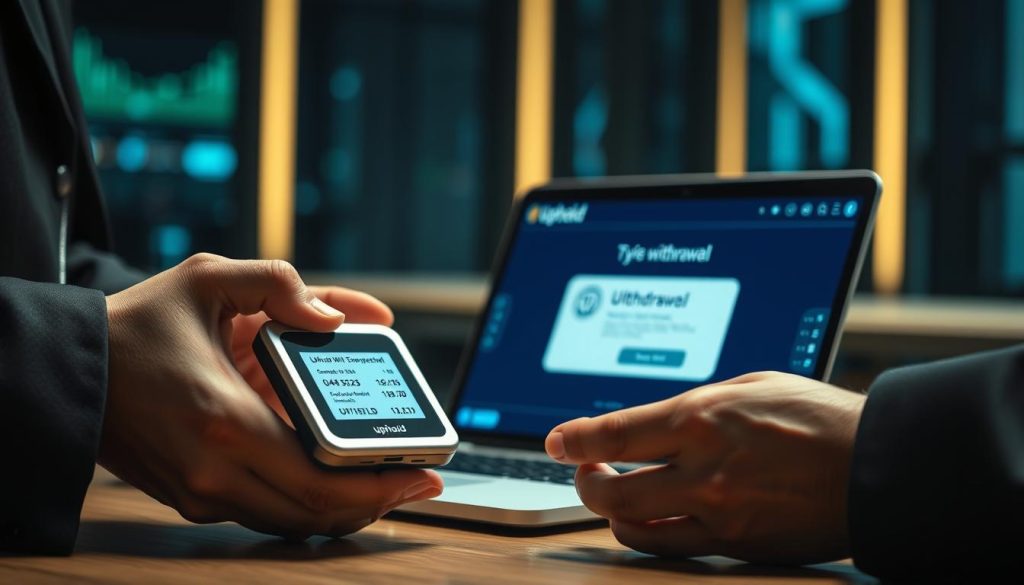
Here’s something that surprised me: over $3.8 billion in cryptocurrency was stolen from exchanges in 2022 alone. That number stuck with me. I decided to move my digital assets off the uphold platform into actual self-custody.
Keeping everything on an exchange feels convenient until it doesn’t.
I remember staring at that first hardware wallet. I wondered if I’d somehow mess up the entire transfer. The addresses looked like random strings of characters.
One wrong click felt like it could send my holdings into the digital void. But here’s what I discovered. The process of executing a secure crypto withdrawal from uphold is actually pretty straightforward.
This guide breaks down everything you need to know about moving your assets to a cold wallet. We’ll cover the step-by-step mechanics and the fees you’ll encounter. We’ll also discuss common mistakes I’ve seen and made.
Offline storage gives you something no exchange can—true ownership. Think of this as the practical walkthrough I wish someone had given me before my first transfer.
Key Takeaways
- Cold wallets provide complete self-custody of your cryptocurrency, eliminating reliance on exchange security
- The withdrawal process involves generating a receiving address, verifying network compatibility, and confirming transaction details
- Transaction fees vary by blockchain and network congestion, impacting total withdrawal costs
- Common mistakes include wrong network selection and address errors, both of which can result in permanent loss
- Hardware wallets like Ledger and Trezor offer the highest security for long-term storage
- Always send a small test transaction first before moving larger amounts
- Uphold may have withdrawal limits and processing times that vary by account verification level
Understanding Cold Wallets and Their Importance
Experienced crypto holders obsess over cold wallets for one reason: control. You need to understand what you’re protecting before moving crypto off Uphold. Cold wallets represent a fundamental shift in owning digital assets.
Too many people learn this lesson the hard way. Exchanges collapse or get hacked, and hot wallet crypto vanishes overnight. Cold storage eliminates that third-party risk entirely.
What is a Cold Wallet?
A cold wallet stays completely disconnected from the internet. Think of it as offline crypto storage in its purest form. The “cold” name refers to no network connectivity.
Your private keys never touch an internet-connected device. This isolation creates a security barrier hackers can’t breach remotely.
The concept sounds simple, but the implications are profound. With cold storage, you become your own bank. No third party can freeze your account or lose your funds.
Benefits of Using a Cold Wallet
Cold wallets offer advantages beyond just better security. After years of using both storage types, specific benefits matter in practice:
- Complete immunity from exchange hacks: Remember Mt. Gox? Quadriga? FTX? None of those disasters could touch cold wallet users. Your crypto stays yours regardless of exchange failures.
- Protection against online threats: Phishing attacks, malware, and remote hacking become irrelevant. If keys never go online, they can’t be stolen online.
- True ownership of assets: Cryptocurrency is a bearer instrument—whoever controls private keys owns the coins. Cold wallets give you that control without intermediaries.
- Transaction intentionality: Extra steps to access cold wallet funds prevent impulsive decisions. That “am I really sure?” moment has saved many regrettable trades.
- Long-term storage peace of mind: For holdings you don’t plan to trade actively, hardware wallet security provides psychological comfort.
The tradeoff is convenience. Accessing funds takes longer and requires physical device interaction. But that friction is actually a feature.
This inconvenience represents appropriate caution. “Not your keys, not your crypto” isn’t just a slogan. The extra security steps feel justified.
Types of Cold Wallets
Not all cold storage solutions are created equal. Each type offers different balances of security and convenience:
Hardware Wallets: These are purpose-built physical devices like Ledger Nano X or Trezor Model T. They store private keys in a secure chip designed to resist tampering. Even if your computer has malware, keys never leave the device.
For most people, hardware wallets offer the best combination. They’re user-friendly, relatively affordable, and support multiple cryptocurrencies.
Paper Wallets: Your private keys printed on paper. This method is cheap and completely offline but fragile. Paper degrades, ink fades, and one spill destroys everything.
Steel Wallets: Steel wallets etch your recovery phrase onto metal plates. They survive fires, floods, and physical deterioration. Many holders keep steel backups in multiple locations.
Air-Gapped Computers: Some users dedicate a computer that never connects to the internet. This offers maximum security but requires technical knowledge. It’s overkill for most people.
Hardware wallet security hits the sweet spot for most users. A reputable hardware wallet provides needed security without unnecessary complexity.
Understanding these options helps you protect your crypto. Moving funds from Uphold to a cold wallet becomes a commitment. You’re choosing true cryptocurrency ownership.
Overview of Uphold Platform
I started using Uphold a couple years back. At first, I couldn’t figure out what kind of platform it was. It’s not a traditional exchange like Coinbase or Kraken.
It’s definitely not a DeFi platform either. Uphold occupies an interesting middle ground in the crypto ecosystem. This makes it both versatile and a little confusing at first.
The platform operates as a multi-asset service. You can hold cryptocurrencies alongside precious metals and fiat currencies. You can even hold carbon credits, all in one account.
It’s kind of bizarre, but also weirdly convenient. This works well if you’re diversifying across different asset classes.
Understanding how the uphold exchange features work matters before you move crypto to cold storage. The platform’s structure affects everything from fees to processing times. Let’s break down what you’re actually dealing with.
Key Features of Uphold
Uphold’s standout characteristic is its multi-asset approach. Unlike most crypto-only platforms, you can seamlessly convert between different asset types. You don’t have to jump through multiple hoops.
I’ve used this feature to shift between Bitcoin and gold certificates. This helped during choppy market conditions.
The platform operates on what they call a “reserve model.” This is different from a traditional order book for certain assets. This caught me off guard initially because pricing can sometimes feel slightly off-market.
They’ve gotten better about transparency here. It’s worth knowing that you’re not always trading peer-to-peer. This differs from how you would trade on a conventional exchange.
Here’s what makes Uphold different from traditional exchanges:
- Instant conversion between 200+ assets without waiting for order matching
- Transparent reserve backing with real-time proof of funds
- No minimum deposits for most account types
- Built-in portfolio tracking across all asset classes
- Direct bank connections in multiple countries including the United States
The uphold exchange features also include something they call “Anything-to-Anything” trading. You can convert directly from Bitcoin to silver. You can also convert from Ethereum to Japanese yen without intermediate steps.
It’s genuinely useful for certain trading strategies. However, this doesn’t change the fundamental recommendation to move long-term holdings off-platform.
Supported Cryptocurrencies
Uphold supports over 200 cryptocurrencies as of this writing. This covers basically everything you’d want to withdraw. All the major players are there—Bitcoin, Ethereum, XRP, Litecoin, Bitcoin Cash.
There’s also a long tail of altcoins. This surprised me when I first explored their listings.
I’ve personally moved Bitcoin, Ethereum, and Cardano through their system without issues. The supported list includes both established projects and newer tokens. However, availability can vary by region due to regulatory considerations.
The diversity matters for uphold external wallet transfers. Not all platforms support the same range of cryptocurrencies. Uphold’s broad support means you can consolidate multiple assets before moving them to cold storage.
| Asset Category | Examples | Withdrawal Support | Typical Confirmation Time |
|---|---|---|---|
| Major Cryptocurrencies | BTC, ETH, XRP, LTC | Full external withdrawal | 10-60 minutes |
| Altcoins | ADA, DOT, LINK, UNI | Full external withdrawal | 15-90 minutes |
| Stablecoins | USDC, USDT, DAI | Full external withdrawal | 10-45 minutes |
| Precious Metals | Gold, Silver, Platinum | Internal only (no blockchain) | Not applicable |
One quirk worth mentioning: some newer or lower-volume tokens might have temporary withdrawal restrictions. This happens during high network congestion. I haven’t personally hit this, but customer forums mention it occasionally.
Security Measures in Uphold
Uphold’s security approach is two-pronged. Understanding it helps explain why the uphold crypto withdrawal process to cold storage makes sense. They claim to hold a significant portion of customer assets in cold storage themselves.
This provides institutional-level protection against hot wallet hacks.
For user-facing security, they offer standard protections:
- Two-factor authentication (2FA) using authenticator apps or SMS
- Biometric login on mobile devices with fingerprint or face recognition
- Email confirmations for withdrawal requests and account changes
- IP whitelisting to restrict account access to known locations
- Activity monitoring with alerts for suspicious behavior
But here’s the critical point that affects your uphold external wallet transfers strategy. You don’t control the private keys when your crypto sits on Uphold. They do.
You’re trusting their security measures, their business continuity, their regulatory compliance.
That’s perfectly fine for active trading or temporary holdings. I keep small amounts on Uphold for quick conversions without worry. But it violates the fundamental crypto principle of “not your keys, not your coins.”
The platform has experienced the usual growing pains. Withdrawal delays during high-volume periods and customer service complaints are standard issues. These problems plague centralized platforms.
None of it is deal-breaking for short-term use. However, these realities reinforce exactly why moving significant holdings to cold storage makes sense. The uphold crypto withdrawal process exists so you can take custody of your own assets.
This matters when you’re ready to prioritize security over convenience.
I appreciate Uphold’s relatively transparent fee structure compared to some competitors. They don’t artificially restrict withdrawals to external addresses. Some platforms make it unnecessarily difficult to move your crypto off their system.
Uphold actually wants to facilitate proper self-custody. This speaks well of their long-term thinking.
Step-by-Step Guide to Withdraw Crypto from Uphold
Let’s get to the practical part—moving your crypto from Uphold to cold storage. I’m assuming you’ve already set up your cold wallet. Your backup phrase should be stored safely.
If you haven’t done that yet, stop right here. Complete that process first before moving forward.
The uphold to hardware wallet transfer process isn’t complicated. However, it requires careful attention at every step. One mistake with an address can mean permanent loss of funds.
I’ve walked through this process dozens of times with different cryptocurrencies. I still double-check everything each time.
This step-by-step crypto withdrawal guide covers everything from logging in to blockchain confirmation. Take your time with each step—there’s no prize for rushing through this.
Accessing Your Uphold Account
Open your web browser or mobile app and go to Uphold’s login page. I prefer using the desktop version for withdrawals because the larger screen helps verify addresses. The mobile app works just as well though.
Enter your credentials and complete the two-factor authentication prompt. If you don’t have 2FA enabled yet, enable it immediately before proceeding. Anyone moving cryptocurrency to cold storage should absolutely have this basic security measure active.
Once you’re logged in, you’ll see your dashboard displaying all your holdings. The interface shows your portfolio balance, recent transactions, and various action buttons. Navigate to the “Transact” or “From” section to view all your cryptocurrency balances.
Initiating the Withdrawal Process
Click or tap on the specific cryptocurrency you want to withdraw. Uphold’s interface will expand to show you several options including Buy, Sell, Send, and Receive. The terminology might vary slightly depending on your version.
Select the “Send to crypto address” or “Transfer” option. This is different from sending to another Uphold user or converting to different cryptocurrency. You’re specifically looking for the option that lets you send to an external blockchain address.
Uphold will present you with a new screen asking for recipient details. Before you enter anything here, let’s talk about preparing your cold wallet address. This is where most people get nervous, and rightfully so.
The platform will show you the available balance and any network-specific options. For some cryptocurrencies like USDT, you might need to select the correct network. This network selection is critical—sending tokens on the wrong network means they’re gone forever.
Selecting the Cold Wallet Address
This is the most critical part of transferring bitcoin from uphold to ledger or any hardware wallet. Open your hardware wallet application—whether that’s Ledger Live, Trezor Suite, or another interface. Navigate to the matching cryptocurrency.
Click the “Receive” button in your hardware wallet software. This displays your wallet’s receiving address, typically a long string of letters and numbers. For Bitcoin, addresses might start with 1, 3, or bc1 depending on the address type.
Ethereum addresses always start with 0x. Each blockchain has its own address format.
Here’s something I learned the hard way: cryptocurrency addresses are blockchain-specific. You cannot send Bitcoin to an Ethereum address, or Litecoin to a Bitcoin address. The blockchains are completely separate, and sending to the wrong type means permanent loss.
Copy the address directly from your hardware wallet using the copy function. Never type it manually—addresses are too long and complex for manual entry without errors. Some hardware wallets like Ledger and Trezor will also display the address on the device screen.
Now comes the paranoid part, but it’s necessary. Paste the address into Uphold’s recipient field. Then verify the first four and last four characters against what’s showing on your hardware wallet.
I do this every single time because clipboard malware exists. This malware actually changes copied addresses to redirect your funds to attackers.
The uphold to trezor withdrawal steps are identical to Ledger or any other hardware wallet. The process depends on getting the address right, not on which specific cold wallet you’re using. If you’re using a Trezor, the address verification happens on the device screen just like with Ledger.
After confirming the address matches perfectly, enter the amount you want to withdraw. You can usually specify an exact amount or select “Max” to send everything minus network fees. I typically leave a small amount in Uphold to cover any future transaction fees.
Review the transaction details screen carefully. Uphold shows you the amount being sent, the network fee, and the total deducted from your account. The recipient address should be fully visible—check it one more time.
Network fees vary based on blockchain congestion. This is normal and expected.
Once you’re confident everything is correct, click the confirm or send button. Uphold will request additional verification through your 2FA method. Enter the code from your authenticator app or confirm via email.
This extra step might feel tedious, but it’s protecting you from unauthorized withdrawals.
After final confirmation, Uphold processes the transaction and provides you with a transaction ID (TxID). Copy this ID and save it somewhere—you’ll use it to track your withdrawal on the blockchain. The transaction typically appears on Uphold’s interface as “pending” or “processing” initially.
Your crypto won’t appear in your cold wallet instantly. Blockchain transactions require network confirmations, which take time depending on the cryptocurrency and current network congestion. Bitcoin typically needs 10-60 minutes, Ethereum anywhere from 1-15 minutes under normal conditions.
You can monitor the transaction progress by entering your TxID into a blockchain explorer. Use Blockchain.com for Bitcoin or Etherscan.io for Ethereum. These tools show you how many confirmations your transaction has received and estimate time remaining.
Once the blockchain confirms your transaction, the cryptocurrency appears in your cold wallet. Your hardware wallet application will update to show the new balance. That first successful uphold to hardware wallet transfer gives you a genuine sense of ownership.
You’re now in complete control of your assets.
| Step | Action Required | Key Safety Check | Estimated Time |
|---|---|---|---|
| Account Access | Log into Uphold with 2FA enabled | Verify secure connection (HTTPS) | 1-2 minutes |
| Select Cryptocurrency | Choose asset from dashboard, click Send | Confirm correct network if applicable | 1 minute |
| Generate Wallet Address | Open hardware wallet app, click Receive | Verify address on device screen | 1-2 minutes |
| Enter Recipient Details | Paste address into Uphold, verify characters | Check first 4 and last 4 characters match | 2-3 minutes |
| Confirm Transaction | Review fees, amount, complete 2FA verification | Final address verification before sending | 2-3 minutes |
| Monitor Blockchain | Use TxID to track confirmation status | Wait for required confirmations | 10-60 minutes |
The process feels intense the first time you do it. It becomes routine with practice though. I still get a small adrenaline rush when confirming large transfers.
That’s probably healthy—it keeps me from getting careless with the details.
Key Considerations Before Withdrawal
Most people focus on what wallet to use. But the withdrawal fees uphold charges and processing times matter just as much. I’ve watched people get frustrated when their withdrawal costs more than expected.
Moving crypto off an exchange involves real costs and variables. You need to understand these before clicking that confirm button. These details directly affect how much crypto reaches your cold wallet and when it arrives.
Understanding Transaction Costs and Fee Structures
Every cryptocurrency withdrawal from Uphold comes with a price tag. The crypto transaction costs aren’t uniform. They change based on which digital asset you’re moving and current network conditions.
Bitcoin withdrawals typically run higher than most altcoins. I’ve personally paid anywhere from $3 to $12 for BTC transfers. This depends on blockchain congestion.
Ethereum can be even more unpredictable. During network spikes, what should cost $5 suddenly balloons to $40 or more.
Here’s what goes into these fees:
- Network transaction fees: Paid to miners or validators who process your transaction on the blockchain
- Uphold’s service fee: The platform’s operational cost and profit margin
- Exchange spread: An additional percentage Uphold adds to conversions and transfers
- Priority pricing: Higher fees during peak network usage times
Something like XRP or Stellar Lumens might only cost a few cents. Their networks are designed for fast, cheap transactions. But Bitcoin and Ethereum blockchains get congested, and miners prioritize transactions with higher fees.
The practical lesson I learned: always check the displayed fee before confirming. Don’t assume it’s what you paid last time. Crypto transaction costs fluctuate with market activity, sometimes dramatically within hours.
Minimum Amounts Required for Withdrawal
You can’t withdraw tiny amounts of cryptocurrency from Uphold. Each digital asset has a minimum crypto withdrawal threshold. You must meet this before the platform will process your request.
These minimums exist for good economic reasons. If the withdrawal fee is $5 and you’re trying to move $3, the math doesn’t work. The transaction would actually cost more than you’re transferring.
Typical minimum crypto withdrawal amounts look like this:
- Bitcoin (BTC): Usually around $10-15 worth
- Ethereum (ETH): Typically $10-20 minimum
- Litecoin (LTC): Generally $10 minimum
- XRP: Often lower, around $5-10
- Stablecoins (USDC, USDT): Usually $10-25 depending on the network
If you’re planning partial withdrawals, you need to think ahead. Make sure you’re leaving enough balance if you want to keep your account active. I’ve seen people try to withdraw everything only to discover they’re $2 short after fees.
The buffer strategy works best. Leave a small cushion beyond the withdrawal amount plus fees. This helps especially if you might need to do another transfer soon.
How Long Withdrawals Actually Take
Timing is probably the most frustrating variable. Uphold processing times involve multiple stages. Not all of them are predictable or fast.
First, there’s Uphold’s internal processing. This usually takes minutes—maybe 10 to 30 under normal conditions. But occasionally they flag withdrawals for additional security review.
This happens most often with your first withdrawal to a new address. It also occurs when you’re moving a large amount.
I’ve had withdrawals sail through in 8 minutes. I’ve also watched them sit in “processing” status for three hours with no explanation. It’s inconsistent, which is why you shouldn’t plan your first withdrawal in a rush.
The blockchain doesn’t care about your schedule. Network congestion, fee levels, and validator priorities all determine when your transaction gets confirmed.
Once Uphold broadcasts your transaction to the blockchain, you’re at the mercy of network conditions. Bitcoin during high traffic periods can take hours even with standard fees. I learned this during the 2021 market peak.
A supposedly “quick” BTC transfer took nearly six hours to get its first confirmation. Ethereum gas prices create their own chaos. During the NFT boom, I paid $50 in fees for what I thought would be $7.
It still took 45 minutes to process. Everyone was outbidding each other on gas prices.
Different networks have different confirmation requirements too:
- Bitcoin typically needs 3-6 confirmations before your cold wallet shows the balance as available
- Ethereum usually requires 12-35 confirmations depending on wallet security settings
- Litecoin processes faster, often needing just 6 confirmations
- XRP and similar assets confirm almost instantly due to different consensus mechanisms
My practical advice based on real experience: do your first withdrawal as a test. Use a small amount when you have time to wait. Not when you need the crypto immediately.
Give yourself a full day buffer if you’re new to this. Once you’ve confirmed that first transaction works, you can move larger amounts with more confidence. Understanding the uphold processing times for your specific cryptocurrency helps.
And always—always—keep enough balance to cover fees plus a tiny buffer. Nothing’s more annoying than being $0.50 short after calculating everything perfectly. Then having to wait for another deposit just to complete your withdrawal.
Common Issues and Troubleshooting Tips
Knowing how to respond makes all the difference when your Uphold withdrawal goes wrong. Uphold transaction issues can pop up unexpectedly, even with careful planning. Most problems have straightforward solutions once you understand what’s happening.
I’ve dealt with my share of hiccups over the years. Withdrawal troubleshooting has become almost second nature. Stay calm and work through the problem methodically rather than panicking.
What to Do if Your Transaction Fails
Transaction failures come in different flavors, and the fix depends on what went wrong. The most common scenario is a withdrawal getting stuck in pending status for hours. This usually happens during high-volume periods when Uphold’s systems are overloaded.
If your withdrawal shows as pending for more than a few hours, check Uphold’s status page. Sometimes they have platform-wide delays they’re actively working through. If it’s just your transaction, you might be caught in a security review.
- First withdrawal to this particular cold wallet address
- Large amount relative to your typical transaction history
- Recent account changes like password resets or email updates
- Withdrawal to an exchange address rather than a personal wallet
These security holds usually resolve within 24 hours. Your funds aren’t lost; they’re just being scrutinized.
A failed crypto withdrawal that gets rejected will typically include an error message. Common culprits include insufficient balance after fees, address format errors, or network-specific issues. Trying to withdraw an ERC-20 token without enough ETH for gas fees will fail every time.
The fix depends on the specific error. Add more balance if you’re short on funds. Double-check and correct the address format, or wait for network issues to resolve.
Your funds return to your Uphold account when a withdrawal fails—they don’t vanish into the crypto ether.
Checking Withdrawal Status
Tracking your withdrawal is straightforward once you know where to look. In Uphold, navigate to your transaction history and find the withdrawal entry. It’ll display a status indicator: pending, completed, or failed.
Once the transaction has been broadcast to the blockchain, you’ll see a transaction ID (TxID). This transaction ID is incredibly useful for withdrawal troubleshooting. Copy that TxID and paste it into the appropriate blockchain explorer for your cryptocurrency.
Use blockchain.com for Bitcoin, etherscan.io for Ethereum, or the relevant explorer for other networks. This shows you real-time confirmation status on the actual blockchain.
This tells you where the holdup is occurring. If the transaction appears on the blockchain explorer with confirmations accumulating, the delay is on the network’s side. If it doesn’t appear at all, Uphold hasn’t broadcast it yet.
I check both locations whenever I’m tracking a withdrawal. The blockchain doesn’t lie—it’s the ultimate source of truth for crypto transactions. Sometimes Uphold’s interface lags behind what’s actually happening on the network.
Contacting Uphold Support
The in-app support chat typically provides the fastest response. Email support can take days, which isn’t helpful for missing transactions. I’ve had mixed experiences with their support team—sometimes surprisingly quick, other times frustratingly slow.
Before you contact uphold customer support, gather the necessary information. Have your transaction ID ready, take screenshots of any error messages, and be specific. Vague requests like “my withdrawal isn’t working” don’t give them enough to go on.
Try something like “My Bitcoin withdrawal to address [ABC123] has been pending for 6 hours.” Include your transaction ID [XYZ789] in your message.
One scenario worth mentioning is the wrong-address withdrawal. If you send crypto to an incorrect address and the transaction confirms, it’s almost certainly gone forever. Blockchain transactions are irreversible by design—that’s actually a feature, not a bug.
The only exceptions are if you accidentally sent to a different address you control. The recipient might also voluntarily return it, but don’t count on that. I’ve heard enough horror stories about thousands lost to a single typo.
This is why the address verification step during withdrawal is so critical. Paranoia is absolutely appropriate here. Copy the address, paste it, then verify at least the first and last six characters match.
Some people even send a small test transaction first before moving larger amounts. This adds an extra step but provides serious peace of mind.
Tools for Managing Withdrawals
The right tools transform sending crypto to cold storage from uphold into a manageable routine. You’re not just moving cryptocurrency from uphold and hoping for the best. You’re setting up an entire ecosystem for secure storage and management.
Let me walk you through the essential tools that actually make a difference. These are based on what I’ve learned works and what doesn’t.
Best Cold Wallets for Security
Two names dominate hardware wallet recommendations: Ledger and Trezor. I’ve tested both extensively. Each has distinct advantages worth considering.
Ledger offers models like the Nano S Plus and Nano X. The interface feels sleeker. They support a wider range of cryptocurrencies than most competitors.
However, they had a customer data breach a couple years back. It exposed personal information, not actual crypto, but still concerning. Prices range from $79 to $149 depending on the model.
Trezor provides the Model One and Model T options. Their open-source philosophy gives them stronger transparency. This matters if you’re privacy-focused.
They support fewer coins natively. What they do support works flawlessly. Price-wise, they’re comparable at $69 to $219.
Beyond these mainstream options, consider these alternatives:
- Coldcard: Bitcoin-only device for maximum security paranoia
- BitBox: Swiss-made option with strong privacy features
- KeepKey: Budget-friendly but with limited cryptocurrency support
For most people starting out with cold storage, either works well. A Ledger Nano S Plus or Trezor Model One hits the sweet spot. They balance security, usability, and price.
Cryptocurrency Portfolio Trackers
Once you’ve completed moving cryptocurrency from uphold to cold storage, tracking its value becomes less convenient. Your assets aren’t sitting in an exchange interface anymore. This is where crypto portfolio tools become essential.
I personally use CoinStats because it aggregates everything in one view. You add your cold wallet addresses in read-only mode. The app can see balances but can’t move anything.
The free version handles basic features. It shows real-time values. It tracks cost basis for tax purposes.
Other solid crypto portfolio tools include:
- Delta: Clean interface with excellent portfolio analytics
- CoinTracker: Powerful tax reporting features for U.S. users
- Blockfolio: Popular option with price alerts and news integration
The tax tracking feature alone justifies using these tools. Manually calculating capital gains across multiple transactions is nightmarish. Trust me on this one—I learned the hard way during my first tax season.
Exchange Rate Tools
Timing matters when you’re sending crypto to cold storage from uphold. Exchange rate tools help you minimize fee impact. They show how fees relate to your holdings’ value.
CoinGecko and CoinMarketCap provide real-time prices across exchanges. You can set up alerts for when specific cryptocurrencies hit target prices. This helps you choose the best time to withdraw.
If you’re withdrawing Bitcoin and the network fee is $10, timing matters. Doing it when Bitcoin is worth $50,000 versus $30,000 doesn’t change the fee amount. But it changes the percentage impact significantly.
Another underrated tool: blockchain explorers themselves. Sites like Blockchain.com, Etherscan.io, and Blockchair.com let you independently verify transactions. You can see confirmation status, fee amounts, and transaction details directly from the blockchain.
Bookmark these and learn how to use them.
Don’t overlook password managers like 1Password or Bitwarden. Use them to securely store your Uphold login credentials. They also hold 2FA backup codes and exchange information.
Never store recovery phrases digitally if you can avoid it. Physical paper or steel backups are better for seed phrases.
I nearly locked myself out of an exchange once. I couldn’t remember which email variation I’d used to sign up. A good password manager prevents these headaches.
The right tools don’t just make withdrawals easier. They make the entire self-custody experience more manageable. They make it way less anxiety-inducing.
Statistics on Cold Wallet Usage
I started tracking hardware wallet market growth a few years back. The numbers climbed much steeper than I expected. The data shows how cryptocurrency users are changing their approach to security.
What began with tech enthusiasts has become mainstream behavior. This shift comes from increased awareness and painful lessons. The crypto community learned these lessons the hard way.
The numbers reveal patterns about trust and risk tolerance. They show how people behave when their money is at stake. These cold wallet adoption statistics evolved from casual forum discussions to serious institutional analysis.
Growth in Cold Wallet Adoption
The hardware wallet market has experienced remarkable expansion over recent years. Industry estimates place the global market value around $250-300 million in 2023. Projections show continued growth at roughly 20-25% annually through 2028.
These aren’t just theoretical numbers. They represent millions of actual devices in people’s hands. The growth reflects real changes in how users protect their crypto.
Ledger reports selling over 5 million devices since their founding. Trezor has moved more than 1 million units. The volume isn’t just impressive—the acceleration tells the real story.
Hardware wallet sales jumped in response to specific events. They didn’t follow a steady upward trajectory. Crisis moments drove the biggest increases.
The FTX collapse in late 2022 serves as a perfect case study. Billions of dollars vanished overnight from the platform. Ledger reported their sales jumped over 50% in the following weeks.
Nothing motivates security consciousness like watching a trusted platform implode. People who’d been “meaning to get a hardware wallet” suddenly made it priority. I remember those conversations in crypto communities during that period.
This pattern repeats throughout crypto history. Major exchange hacks trigger spikes in cold storage adoption. The crypto storage trends data shows user behavior changes most after high-profile security incidents.
Comparison: Hot Wallet vs. Cold Wallet Security
Security incident data from 2012 through 2023 shows a stark contrast. Exchange hacks and hot wallet compromises account for stolen cryptocurrency. Analysis shows they represent over 90% of stolen cryptocurrency by value.
| Security Metric | Hot Wallets | Cold Wallets |
|---|---|---|
| Major Theft Incidents | Hundreds documented (Mt. Gox, Coincheck, Poly Network) | Extremely rare, almost all from user error |
| Primary Attack Vector | Network-based hacks, exchange vulnerabilities | Physical theft, phishing for seed phrases |
| Remote Breach Possibility | High exposure to online threats | Essentially zero when properly used |
| Dollar Value Stolen (2012-2023) | Billions across multiple incidents | Minimal, mostly supply chain attacks |
The difference in hot vs cold wallet security comes down to attack surface. Hot wallets stay connected to the internet constantly. This creates continuous vulnerability that hackers can exploit.
Cold wallets eliminate that exposure entirely. A properly configured hardware wallet is essentially unbreachable remotely. The private keys never leave the device.
Cold wallet compromises that do occur almost always involve human error. Someone falls for a phishing scam and reveals their seed phrase. A device gets stolen without proper PIN protection.
In rare cases, supply chain tampering occurs before the wallet reaches customers. These scenarios are preventable through careful practices. Network attacks on hot wallets can’t be directly controlled by users.
User Trends in Cryptocurrency Storage
Different types of crypto users approach storage in interesting patterns. Long-term holders prefer cold storage overwhelmingly. Surveys suggest 70-80% of people holding crypto for over a year use hardware wallets.
Active traders follow different patterns from long-term holders. They keep more funds in hot wallets and on exchanges. Frequent trading makes cold storage transfers impractical.
I follow this split strategy myself for convenience. Small amounts for active trading stay accessible on exchanges. Serious long-term holdings go straight to my Ledger.
Most people tolerate keeping crypto on exchanges up to a certain amount. That threshold might be $1,000 to $5,000 depending on risk tolerance. Once holdings cross that personal threshold, they move excess to cold storage.
Geographic differences add another layer to these crypto storage trends. Regions with less stable financial systems show higher cold wallet adoption. Countries like Venezuela, Argentina, and Nigeria use hardware wallets disproportionately.
The autonomy and seizure-resistance of cold storage matters practically in these regions. It’s not just theoretical for these users. Cold storage becomes essentially necessary for protecting assets.
Multi-signature cold storage is growing among institutions and high-net-worth individuals. This approach requires multiple separate keys to authorize transactions. It adds another security layer beyond standard cold storage.
Multi-sig remains relatively complex for average users currently. But the principle eliminates single points of failure. This represents where cold storage technology is heading.
Cold storage has transitioned from fringe practice to standard procedure. Anyone serious about cryptocurrency ownership now uses cold storage. The data backs up what many of us have observed firsthand.
Predictions for Crypto Withdrawal Processes
Cold wallet technology is evolving rapidly, much like the early internet did. I’ve tracked developments in this space for the past year. The trajectory is exciting and full of promise.
Withdrawing from exchanges like Uphold to cold storage is getting easier and more secure. These two improvements don’t always happen together in technology. The changes ahead will transform how we manage our digital assets.
The industry is finally addressing the usability problem that has plagued crypto for years. Current withdrawal processes work fine for crypto enthusiasts. However, they’re intimidating for regular people.
That’s changing fast. The next generation of tools will make moving your assets off-platform feel natural. It will be as simple as transferring money between bank accounts.
We’re already seeing early signals of this transformation happening now. Companies are realizing the main barrier to adoption isn’t price or trust. It’s perceived complexity.
Last month, my neighbor asked me about cryptocurrency withdrawal innovation. I had to walk him through a process that felt needlessly complicated. In two years, that conversation will be completely different.
Evolving Security Standards
The future of crypto security is moving toward social recovery and multi-party computation models. Traditional seed phrases are both the most secure and most vulnerable part of cold storage. These 12 or 24 words are critical to guard.
Lose them, lose everything. Someone steals them, they steal everything. This creates a serious vulnerability in current systems.
Newer approaches split the key across multiple locations or parties. No single point of failure exists anymore. Argent wallet pioneered this concept for hot wallets.
Hardware wallet makers are exploring similar implementations. I’m cautiously optimistic about this development. It could eliminate the nightmare scenario where lost seed phrases mean permanently lost funds.
Biometric authentication is also coming to hardware wallets themselves. Imagine unlocking your cold wallet with a fingerprint instead of a PIN. The technology already exists in smartphones.
Adapting it for crypto storage is a natural evolution. This addresses one practical problem I’ve experienced. We already remember too many passwords and PINs.
Platforms face increasing pressure to implement better verification without creating friction. We’ll probably see more sophisticated risk scoring systems. Your first withdrawal to a new address might face extra scrutiny.
Once you establish a pattern, subsequent transfers become almost instant. Some exchanges are experimenting with address whitelisting that includes a 24-48 hour delay. You add your cold wallet address and wait during a security period.
You can cancel if your account is compromised during this time. After that, withdrawals become fast and low-friction. This balances security with convenience.
Future Trends in Cold Wallet Technology
The cold wallet technology trends I’m watching most closely involve user interface improvements. Current hardware wallets have that “designed by engineers for engineers” aesthetic. The next generation devices already in development will feature larger touchscreens.
They will offer better visual verification of addresses and more intuitive navigation. The goal is making cold storage accessible to people who struggle with technology. It shouldn’t be just for early adopters.
Visual confirmation systems represent a significant leap forward. Instead of squinting at alphanumeric addresses hoping you didn’t make a typo, newer systems use QR codes. Your cold wallet screen shows a unique pattern.
Your phone or computer shows the same pattern, and you confirm they match. Simple, effective, and far less error-prone than current methods. This reduces human error significantly.
Blockchain technology itself is evolving toward lower fees and faster confirmations. Layer 2 solutions for Bitcoin like Lightning Network are maturing rapidly. Ethereum solutions like Optimism are also advancing quickly.
Within a few years, withdrawing Bitcoin might routinely happen via Lightning with near-instant settlement. Fees will be measured in pennies, not dollars. Cold wallets are already starting to support these technologies.
The user experience shifts from “initiate withdrawal and wait anxiously for confirmations” to instant completion. I’ve tested some early Layer 2 implementations. The difference is remarkable.
What used to take 30 minutes now takes 30 seconds. That kind of improvement fundamentally changes how people interact with their crypto. Speed matters for user adoption.
Integration is another trend that’s accelerating rapidly. Expect your cold wallet to increasingly interface directly with DeFi protocols and NFT platforms. You won’t need to move funds back to a hot wallet first.
Ledger and Trezor are already adding features like this, but it’ll expand significantly. Your cold wallet becomes less of a vault you rarely open. It becomes a secure key that enables safe interaction with the entire crypto ecosystem.
Market Adaptation and User Preferences
Market adaptation will be driven heavily by regulation, whether we like it or not. Virtually every major economy is working on clearer crypto regulations right now. Exchanges will need to balance compliance requirements with user experience.
The philosophical tension here is important to consider. Will increased regulation come at the cost of decentralization? That’s what made crypto attractive in the first place.
I predict we’ll see more seamless integration between traditional finance and crypto. Withdrawals might become as routine as bank transfers are today. The regulatory frameworks emerging in the United States and Europe are creating helpful standards.
Clearer rules mean exchanges can optimize their processes without legal uncertainty holding them back. This could actually improve the withdrawal experience. Regulation isn’t always bad for users.
User preferences are clearly shifting toward self-custody, and this trend will accelerate. The next generation of crypto users will likely consider cold storage as the default. It won’t be seen as the advanced option anymore.
This behavioral shift is already influencing how platforms design their withdrawal flows. They’re making it easier, not harder, to move assets off-platform. This is a healthy development for the ecosystem.
Exchanges focusing on being excellent on-ramps and trading venues creates a healthier ecosystem. They shouldn’t try to keep your assets captive. User surveys from 2023 compared to 2020 show striking changes.
People are demanding better withdrawal options, and the market is responding. This aligns incentives better for everyone involved. Users get more control over their assets.
| Aspect | Current State (2024) | Predicted Future (2027-2028) | Impact on Users |
|---|---|---|---|
| Withdrawal Speed | 10-60 minutes average | Under 5 minutes via Layer 2 | Reduced anxiety, improved liquidity |
| Security Method | Seed phrase dependency | Multi-party computation options | Lower risk of permanent loss |
| User Interface | Technical, command-driven | Visual confirmation, touchscreen | Mass market accessibility |
| Withdrawal Fees | $5-$25 typical | Under $1 with Layer 2 | More frequent self-custody |
| Regulatory Environment | Fragmented, uncertain | Standardized frameworks | Increased confidence and clarity |
The data in this comparison table reflects both current industry benchmarks and reasonable projections. These projections are based on technology already in development. What strikes me most is how these improvements work together.
Faster speeds enable lower fees. Better interfaces encourage adoption. Clearer regulations reduce friction for everyone involved.
One trend I’m watching with particular interest is how younger users approach crypto storage. People who grew up with smartphones have different expectations about technology. They expect things to “just work” while remaining secure.
The industry is finally catching up to those expectations. The withdrawal process will benefit enormously from this generational shift in design philosophy. Better design means better adoption rates.
FAQs About Withdrawing Crypto from Uphold
Moving crypto from Uphold to a cold wallet raises many practical questions. The stakes are high and the process feels irreversible—which it absolutely is. I’ve compiled the most common concerns I hear from people navigating this process for the first time.
Understanding uphold withdrawal safety eliminates most of the anxiety surrounding this process. The mechanics behind blockchain transactions are straightforward once you know them. Let’s tackle the big questions head-on.
Is it Safe to Withdraw to a Cold Wallet?
Yes—in fact, it’s significantly safer than leaving your crypto on Uphold or any exchange platform. The uphold to cold wallet security model fundamentally changes your risk profile for the better. Cold wallets offer protection that exchanges simply cannot match.
The withdrawal process itself carries minimal risk if you follow proper address verification procedures. The main vulnerability point is entering the wallet address. If you get that right, the rest is extremely secure.
Cold wallets are specifically designed to be safe storage solutions. They keep your private keys isolated from internet threats. Your assets remain protected from remote attacks and hacking attempts.
The “risk” comes entirely from user error—wrong address, lost seed phrase, physical damage without backups. The blockchain transaction itself is cryptographically secure and irreversible. This permanence is both a feature and a potential problem.
In over a decade of cold wallet technology being available, there hasn’t been a verified case of someone’s crypto being stolen directly from a properly used hardware wallet through a remote attack.
That’s a safety record traditional financial systems can’t match. Exchanges get hacked regularly. Banks have fraud issues.
But a cold wallet sitting in your desk drawer? Essentially impenetrable from external digital threats. The technology has proven itself time and again.
The uphold withdrawal safety concerns you should focus on are procedural, not technological. Verify addresses carefully and back up your seed phrase in multiple physical locations. Test with small amounts first.
Can I Withdraw Different Cryptocurrencies Together?
No, you have to withdraw each cryptocurrency separately. This isn’t an Uphold restriction—it’s a fundamental blockchain limitation that applies universally. Every blockchain operates independently from others.
Bitcoin exists on the Bitcoin blockchain, Ethereum on the Ethereum blockchain, and so on. They’re completely separate systems that don’t communicate with each other. Each requires its own transaction process.
You can’t bundle them into one transaction. What you can do is withdraw multiple cryptocurrencies in sequence, one after another. Each requires its own withdrawal process with the appropriate address for that specific crypto.
This also means you need a cold wallet that supports all the cryptocurrencies you want to withdraw. Most modern hardware wallets support dozens or hundreds of different coins. It’s worth verifying before initiating withdrawals.
Here’s what the process looks like in practice:
- Withdraw Bitcoin using your cold wallet’s Bitcoin receive address
- Withdraw Ethereum using the Ethereum address from the same device
- Withdraw XRP using the XRP address, including the required destination tag
- Each transaction has its own fee and processing time
- Each appears as a separate entry in your transaction history
For these cold wallet FAQs, this question ranks among the most common. People assume crypto works like traditional banking where you can bundle multiple transfers. It doesn’t, and understanding that distinction prevents confusion during the withdrawal process.
What Happens if I Input the Wrong Wallet Address?
This is the nightmare scenario, and the answer is uncomfortable: your crypto is almost certainly gone forever. Blockchain transactions are irreversible by design—once confirmed, there’s no “undo” button. There’s no customer service to call and no charge-back mechanism.
If you send Bitcoin to an invalid or incorrectly formatted address, the transaction will usually fail. Your funds return in this case. But that’s the rare exception, not the rule.
More commonly, if you send to a valid address that you don’t control, the funds arrive there permanently. Maybe you transposed a character, or clipboard malware changed the address. The funds are now controlled by whoever holds those private keys, which isn’t you.
There’s no recovery mechanism. The recipient could voluntarily return the funds. But good luck even identifying who they are, much less convincing them to give back free money.
This is why verification is absolutely critical to uphold to cold wallet security. Follow these protective measures every single time:
- Copy-paste the address, never type it manually
- Verify the first and last several characters match what your cold wallet displays
- If the amount is significant, do a small test transaction first
- Send $20 worth, confirm it arrives correctly, then send the rest
- Use wallet address book features when available
Yes, you pay two transaction fees instead of one with a test transaction. But it’s cheap insurance against a catastrophic mistake. That mistake could cost thousands or even tens of thousands of dollars.
Some wallets now have address book features or ENS (Ethereum Name Service) addresses. These use human-readable names instead of cryptographic strings. These innovations help reduce errors significantly.
For Uphold withdrawals specifically, they do some basic validation. If you try to send Bitcoin to an Ethereum address format, it’ll usually catch that. It prevents the transaction from going through. But it won’t catch valid-format-but-wrong addresses—that’s on you.
Additional common crypto withdrawal questions worth addressing:
How long does withdrawal take? Uphold’s internal processing typically takes minutes to a couple hours. Blockchain confirmation depends on network conditions. Bitcoin averages 10 minutes per block but needs multiple confirmations. Total time is usually 30 minutes to an hour for Bitcoin, 15 minutes for Ethereum.
Is there a withdrawal limit? Uphold has daily and monthly withdrawal limits. These vary based on your account verification level. For fully verified accounts, daily limits typically range from $10,000 to $50,000. Check your account settings for your specific limits.
Can I cancel a withdrawal after submitting? Before Uphold broadcasts the transaction to the blockchain, sometimes—there’s a brief window. Contact support immediately if you need to cancel. Once it’s broadcast to the blockchain, absolutely not. It’s irreversible at that point.
Do I need to keep my Uphold account active after withdrawing? No, once your crypto is in your cold wallet, you have no dependency on Uphold. You could close your account entirely if you wanted. The crypto exists on the blockchain, controlled by your private keys.
Uphold was just the intermediary to get it there. That independence is the entire point of self-custody. It represents the fundamental philosophy behind cold wallet protection.
Evidence of Improved Security with Cold Wallets
The difference between theoretical security and proven protection becomes clear when you study cryptocurrency theft prevention history. We have over a decade of real-world data showing how different storage methods perform against actual threats. The crypto security evidence is compelling and remarkably consistent.
Looking at this data changed how I think about wallet security. Theory is nice, but nothing beats seeing how systems actually hold up under pressure.
Major Cryptocurrency Theft Incidents
The history of cryptocurrency theft reads like a cautionary tale about keeping assets online. Every major breach involves hot wallets or exchange systems connected to the internet. The pattern is so consistent that it becomes impossible to ignore.
Mt. Gox lost 850,000 Bitcoin in 2014—worth about $450 million then, over $20 billion at today’s prices. The theft happened because they kept the vast majority in hot wallets connected to their trading system. Hackers gained access over time through system vulnerabilities.
If those funds had been in cold storage with proper procedures, the theft would have been impossible. That’s not speculation—it’s just how the technology works.
Bitfinex lost 120,000 BTC in 2016 through a hot wallet exploit. Coincheck lost $530 million in NEM tokens in 2018—hot wallet again. The DAO hack, Parity wallet bugs, Poly Network’s $600 million theft—all hot wallet or smart contract vulnerabilities.
These cold wallet case studies reveal something crucial: your crypto can’t be hacked remotely if it isn’t connected. The technology barrier is absolute.
| Incident | Year | Amount Lost | Attack Vector |
|---|---|---|---|
| Mt. Gox | 2014 | 850,000 BTC | Hot wallet system compromise |
| Bitfinex | 2016 | 120,000 BTC | Hot wallet vulnerability |
| Coincheck | 2018 | $530 million | Hot wallet breach |
| Cold Wallets | 2009-2024 | Minimal losses | Physical/social engineering only |
Now consider documented cases of cold wallet theft. They exist, but they’re dramatically different in nature. Almost all involve physical compromise or social engineering—not technical vulnerabilities.
There was a case in the UK where someone had their Ledger stolen during a home robbery. But because it was PIN-protected, the thieves couldn’t access anything. The owner recovered everything using their seed phrase with a new device.
That’s the security model working exactly as designed. The hardware wallet effectiveness comes from separating the vulnerability types.
Real User Experiences with Cold Storage
User testimonials provide another layer of crypto security evidence that’s hard to dismiss. Reddit, Twitter, and crypto forums are full of stories from people who dodged disasters. They survived because they used cold storage.
During the FTX collapse in November 2022, thousands lost access to billions held on the exchange. Anyone who had previously withdrawn to cold storage remained completely unaffected. I saw countless posts from people expressing relief that they’d moved their holdings to hardware wallets.
Even though it seemed like unnecessary paranoia at the time, moving everything to my Ledger in 2021 saved my entire crypto portfolio when FTX went under. Best decision I ever made.
These aren’t isolated incidents. Every exchange failure or security breach produces similar stories. The people using cold wallets consistently come through unscathed.
What struck me was how many people described feeling foolish for being “too cautious” right up until disaster struck. That pattern repeats over and over.
There’s also negative evidence worth considering: the absence of major cold wallet failures. After over a decade of hardware wallets securing billions in value, we haven’t seen a Mt. Gox-scale loss. This applies only to properly implemented cold storage.
Research Data on Storage Security
Academic and industry research consistently validates what the case studies show. A 2023 report from Chainalysis found that funds held in cold wallets have a theft rate over 99% lower. This compares to funds in hot wallets or exchanges when adjusted for total value held.
That’s not a small difference. It’s a fundamentally different risk profile. The cryptocurrency theft prevention advantages aren’t marginal—they’re categorical.
The NIST cybersecurity framework, when applied to cryptocurrency, essentially describes cold storage procedures. Academic research on crypto security universally recommends cold storage for any holdings that don’t need immediate liquidity.
Cryptographic researchers have attempted to find vulnerabilities in major hardware wallets. While they’ve discovered some theoretical attack vectors, none have resulted in significant real-world thefts. These attacks usually require physical access and specialized equipment.
Manufacturers patch vulnerabilities in firmware updates once they’re found. The security model has held up remarkably well under sustained scrutiny.
Perhaps the most compelling evidence comes from revealed preference: what do the most security-conscious participants actually do? Large institutional holders, crypto exchanges themselves, and long-term investors overwhelmingly use cold storage solutions.
Companies like MicroStrategy hold billions in Bitcoin, and it’s not sitting in a hot wallet. It’s in sophisticated cold storage systems with multiple geographic locations. These systems require multi-signature authorization.
If the people with the most to lose and the most expertise choose cold storage, that tells you everything. That demonstrates hardware wallet effectiveness beyond any doubt.
The evidence isn’t just statistical—it’s lived experience by millions of users who’ve protected their assets successfully for years. Meanwhile, exchange after exchange proves that keeping crypto online is a question of when, not if, something goes wrong.
That track record speaks louder than any theoretical security analysis ever could. The data is clear, consistent, and convincing.
Conclusion: Best Practices for Cryptocurrencies
Moving crypto from Uphold to cold storage gets easier with practice. Your first attempt might feel scary. By the tenth time, it becomes routine.
Quick Review of Essential Steps
Set up your cold wallet first. Back up that seed phrase properly. Log into Uphold with two-factor authentication turned on.
Select your cryptocurrency and grab the receive address from your cold wallet. Paste that address into Uphold’s withdrawal interface. Double-check every character carefully.
Specify your amount while accounting for fees. Confirm and track the transaction ID. Each step matters because mistakes cost real money.
Why Secure Storage Matters
Secure cryptocurrency management protects your digital money. Exchanges get hacked and accounts get compromised. Cold storage puts control back in your hands.
Use Uphold for trading, then move holdings to cold storage. This approach keeps your crypto safe long-term.
Moving Forward with Confidence
These withdrawal practices become natural with repetition. Start with a small test transaction. Verify everything twice before confirming.
Keep your seed phrase backed up in multiple secure locations. Your anxiety during the first withdrawal turns into confidence quickly. You’re taking real ownership of digital assets.