Here’s a number that stopped me cold: $10 trillion. That’s Elon Musk’s projection for Tesla’s humanoid robotics program revenue. Not millions. Not billions. Trillions.
I’ve followed tech announcements long enough to recognize hype. But what caught my attention wasn’t just the bold claim. It was the evidence backing it up.
Tesla’s Optimus AI isn’t sitting in some research lab collecting dust. These machines are already performing tasks in Tesla manufacturing facilities right now. Real work. Real environments.
The technological leap happening behind the scenes is staggering. The AI models powering these robots jumped from below-average intelligence scores. They went from 80-93 to above-average performance of 95-130 in just six months. That’s not gradual improvement—that’s a breakthrough.
This piece breaks down what Tesla Optimus AI actually represents. We’ll explore where the technology stands today. You’ll learn why this humanoid robot revolution might reshape entire industries faster than expected.
Key Takeaways
- Tesla projects over $10 trillion in potential revenue from its humanoid robotics program
- These robots are already operational in Tesla factories performing real manufacturing tasks
- AI intelligence scores improved from 80-93 to 95-130 in just six months, showing rapid advancement
- Tesla plans to produce thousands of units in 2024, with business deployment starting in 2025
- The technology leverages Tesla’s existing autonomous driving AI infrastructure for faster development
- Musk positions this as potentially more transformative than the iPhone’s impact on society
Introduction to Optimus AI
Tesla isn’t just building another robot. They’re solving a completely different problem. This isn’t a research project sitting in a university lab.
It’s a humanoid robot designed for real-world deployment at scale. The approach differs from what other companies have tried in robotics.
Tesla began with proven AI systems. Then they asked how to give them physical presence. They didn’t start with the physical form and add intelligence later.
What is Optimus AI?
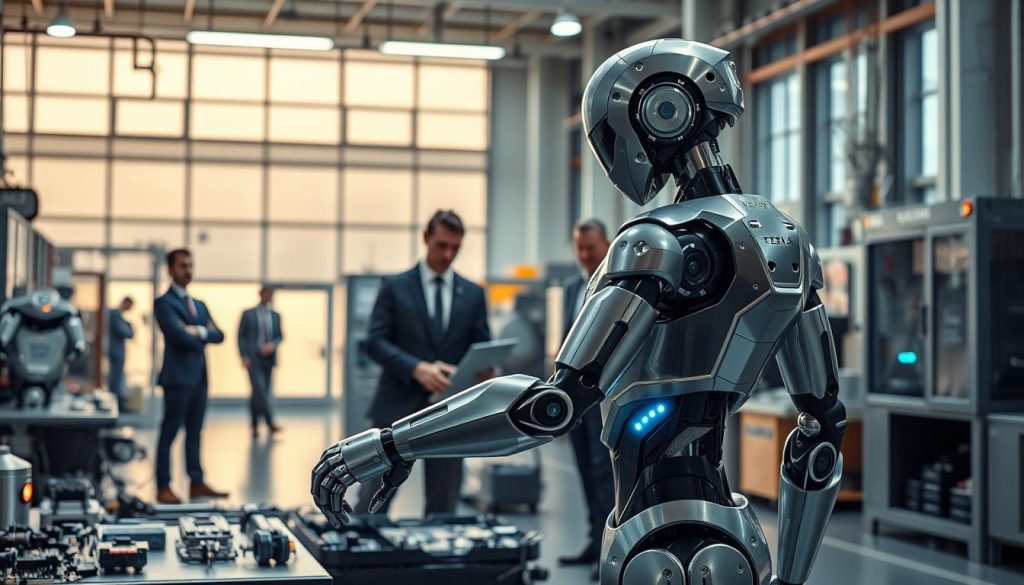
The tesla bot represents Tesla’s entry into humanoid robotics. But that description undersells it significantly. Think of it as a mobile AI platform in human-shaped form.
The “AI” part isn’t just marketing speak. This machine runs on Tesla’s Full Self-Driving neural network architecture.
Autonomous driving is essentially a robotics problem. It involves perception, decision-making, and navigation happening in real-time. Tesla took that foundation and put it in a body instead of a car.
The physical specifications are practical rather than flashy:
- Roughly human height and proportions for compatibility with existing environments
- Bipedal locomotion system allowing navigation through spaces designed for people
- Manipulator hands capable of handling delicate objects without crushing them
- Onboard processing powered by Tesla’s custom AI chips
- Battery system derived from automotive technology
Here’s what separates it from previous humanoid attempts. It’s designed for mass production from day one. Not a research curiosity or limited-run demonstration unit.
An actual product meant to scale into thousands, then millions of units. The tesla optimus capabilities extend across multiple domains. These previously required specialized equipment.
Optimus units are operational within Tesla’s manufacturing facilities. They perform light-duty tasks right now. They’re not just theoretical prototypes.
They’re working, learning, and improving with each shift. The learning capability makes this particularly interesting.
It’s not just programmed for specific tasks. It can adapt to new situations through observation and training. This works similar to how Tesla vehicles improve through fleet learning.
The Vision Behind Tesla’s Robotic Endeavor
Elon Musk’s vision follows a logical thread through Tesla’s other ventures. He sees physical labor shortages intersecting with AI capabilities. This creates massive demand for humanoid robots.
Demographic decline in developed nations means fewer workers entering the labor force. Meanwhile, AI improvements are accelerating exponentially. These two trends create what Musk believes will be history’s largest market opportunity.
“Optimus will ultimately be worth more than the car business and FSD.”
The tesla bot is designed to handle “dangerous, repetitive, and boring” tasks. The ones that cause workplace injuries. The ones humans don’t want to do but someone has to.
The strategic components of this vision include:
- Addressing labor shortages: Demographic trends show declining working-age populations across developed economies
- Reducing workplace injuries: Physical labor causes millions of injuries annually that robots could eliminate
- Scaling beyond automotive: Expanding Tesla’s AI capabilities into a much larger addressable market
- Creating general-purpose utility: Unlike specialized industrial robots, a humanoid robot can theoretically handle diverse tasks
That’s the theoretical framework. But theory and execution are different things entirely. The fact that Optimus units are already working in Tesla facilities matters.
It demonstrates that tesla optimus capabilities have moved beyond concept into practical application. Tesla is using their own facilities as the testing ground.
They’re not selling vaporware or making promises about future functionality. They’re deploying these machines in their own operations. They identify problems and iterate solutions.
Musk has suggested that Optimus could become the most transformative product in history. Bold claim? Absolutely.
But the logic of automating physical labor at scale makes sense. It’s not entirely unreasonable to think it could outshine even the iPhone.
Key Features of Tesla’s Optimus AI
Let me break down what makes Optimus technically compelling. These aren’t small improvements—they’re architectural differences. The features represent a different approach to advanced robotics altogether.
Tesla leverages its existing infrastructure in ways most competitors can’t easily replicate. What caught my attention wasn’t any single standout capability. It was how the entire system integrates.
Tesla didn’t build a robot in isolation. They extended their automotive AI brain into a humanoid form factor.
Advanced AI Capabilities
Optimus processes the world through neural network architecture trained on massive datasets. It uses the same fundamental approach Tesla developed for vehicle autonomy. Here’s what makes this significant: the robot interprets visual information exclusively through cameras.
No LIDAR. No depth sensors as primary inputs. This camera-only philosophy mirrors Tesla’s Full Self-Driving technology.
The neural network learns to understand three-dimensional space from two-dimensional images. This works much like human vision. I’ve watched demo footage where Optimus sorts objects on a table.
What struck me wasn’t the speed—Boston Dynamics robots move faster. It was the contextual understanding. The robot adapts to variations in object placement and orientation without pre-programmed motion paths.
That’s real-time AI processing translating visual input into autonomous capabilities. The system handles several critical functions simultaneously:
- Computer vision processing that identifies objects, obstacles, and spatial relationships
- Real-time decision making that adjusts movements based on environmental feedback
- Task learning that improves performance through repetition and data collection
- Force feedback interpretation for delicate manipulation tasks
Currently, Optimus performs light-duty tasks in Tesla manufacturing facilities. These aren’t publicity stunts—they’re real-world testing environments. The robot learns through actual work.
Human-like Mobility and Design
Bipedal locomotion remains one of robotics’ hardest challenges. Walking on two legs requires constant balance adjustments and weight distribution calculations. It also demands terrain adaptation.
Optimus walks with a gait that’s still somewhat mechanical. However, it’s improving rapidly between iterations. The hands deserve special attention.
Each finger actuates independently with enough force sensitivity to handle fragile objects. I watched footage of an Optimus unit handling eggs. That task sounds trivial until you consider the real-time feedback required.
Crushing an egg takes roughly 25 pounds of force. A firm handshake uses about 50 pounds. The robot needs to distinguish between these pressure levels in milliseconds while maintaining grip stability.
That requires sophisticated actuators paired with sensory feedback loops.
| Physical Capability | Specification | Practical Application |
|---|---|---|
| Walking Speed | 5 mph maximum | Factory floor navigation |
| Lifting Capacity | 45 pounds | Parts handling and assembly |
| Hand Dexterity | 11 degrees of freedom per hand | Object manipulation and tool use |
| Height/Weight | 5’8″ / 125 pounds | Human workspace compatibility |
The design philosophy prioritizes practical utility over aesthetic perfection. This isn’t meant to pass for human. It’s built to work alongside humans in environments designed for human proportions.
Doorways, stairs, workbenches, tools—all sized for our bodies. Optimus fits that same dimensional envelope. Tesla uses custom actuators designed in-house rather than sourcing commercial servos.
This vertical approach means they control the entire stack from motor design to AI algorithms. That integration shows in the smooth coordination between dozens of moving parts.
Integration with Tesla’s Ecosystem
Here’s where Tesla’s broader business creates genuine advantages. Optimus doesn’t exist in isolation. It’s part of an established AI infrastructure that took years and billions to develop.
Software updates deploy across entire robot fleets simultaneously. This works just like Tesla vehicles receive over-the-air updates. A programming improvement discovered at one facility can propagate to all units overnight.
Learning from one robot theoretically transfers to all robots through shared neural network training. The charging infrastructure already exists. The AI training pipeline already processes petabytes of data.
The manufacturing capabilities already produce millions of electric motors and battery packs annually. Tesla’s proprietary AI chips—designed specifically for neural network processing—power both their cars and their robots.
This vertical integration advantage matters more than most people realize. Competitors building humanoid robots from scratch need to develop or source every component. They need actuators, sensors, compute hardware, AI frameworks, training infrastructure, and manufacturing capacity.
Tesla already has most of that. I’ve studied enough startups to know that supply chain and infrastructure challenges kill promising technologies. They do this as often as technical problems do.
Tesla sidesteps many of those challenges because their automotive business already solved them at scale. The software frameworks behind Optimus evolved from years of autonomous driving research.
Machine learning models trained on billions of miles of road data inform how the robot interprets visual information. They also predict movement outcomes. That’s not a capability you can quickly replicate—it’s institutional knowledge embedded in code and trained models.
Tesla’s approach represents something new in advanced robotics. They’re applying automotive-scale engineering and AI development to humanoid form factors. Whether that strategy succeeds long-term remains to be seen.
But the technical foundation they’re building on is substantially different from what academic labs or robotics startups typically work with.
Historical Context of Humanoid Robotics
Humanoid robotics has a longer history than most people realize. It’s filled with more failures than successes. The dream of creating machines that move like humans dates back to the 1960s.
The gap between imagination and execution remained enormous for decades. Understanding this historical development gives us perspective. Optimus represents a significant leap forward.
Early attempts at building a humanoid robot were ambitious. Engineers had vision but lacked the technology to make it work reliably. The robotics evolution moved slowly at first.
Primitive computers and mechanical limitations constrained progress. Those constraints seem almost comical today.
The Long Road of Robotic Development
The first real humanoid robot, WABOT-1, emerged from Waseda University in Japan in 1973. This machine could barely walk across a room without assistance. It moved at a glacial pace and required constant monitoring.
But it proved the concept was possible. Practical application remained decades away.
Honda’s ASIMO changed everything when it debuted in 2000. Those early demonstrations represented a genuine breakthrough in bipedal locomotion. ASIMO could walk up stairs, recognize faces, and respond to voice commands.
The engineering behind its balance system was remarkable for that era.
But here’s the thing—ASIMO remained a research project. Honda spent millions developing it without finding a clear commercial application. It toured trade shows and impressed audiences, yet never transitioned from prototype to product.
Boston Dynamics pushed boundaries further with Atlas, their dynamic humanoid robot. Those videos of Atlas doing parkour genuinely impressed from an engineering standpoint. The machine could maintain balance while jumping, running, and even doing backflips.
Yet Atlas remained a research platform without commercial deployment.
The turning point arrived between 2015 and 2020. Several critical factors converged simultaneously:
- AI neural networks matured dramatically, enabling real-time decision-making and adaptive behavior
- Computing power increased exponentially while costs dropped, making sophisticated onboard processing feasible
- Battery technology improved significantly, extending operational time beyond laboratory demonstrations
- Labor shortages strengthened the business case for automation across multiple industries
This convergence transformed humanoid robotics from academic curiosity to commercial possibility. The robotics evolution accelerated rapidly once these prerequisites aligned.
Breakthrough Moments That Enabled Modern Humanoids
Several major milestones created the foundation for robots like Optimus. Each breakthrough built on decades of prior work. Their combination reached critical mass only recently.
That’s why multiple companies pursued humanoid robot projects simultaneously around 2020-2022.
Efficient electric actuators solved a fundamental problem that plagued earlier designs. Traditional hydraulic systems were powerful but messy, heavy, and complicated. Modern electric actuators provide comparable strength with better control and reliability.
Tesla leveraged their electric motor expertise directly into Optimus’s joint design.
Advances in computer vision and neural networks gave robots the ability to perceive their environment meaningfully. Earlier humanoid robots relied on pre-programmed movements in controlled settings. Modern systems process visual information in real-time, adapting to unexpected obstacles and changing conditions.
“The development of humanoid robots represents humanity’s attempt to create machines in our own image, but success requires more than mimicry—it demands fundamental breakthroughs in perception, balance, and decision-making.”
Tesla’s Full Self-Driving development created an unexpected foundation for Optimus. The same neural networks processing road conditions could adapt to process spatial awareness for a walking robot. This cross-pollination between automotive AI and humanoid robot development wasn’t coincidental—it was strategic.
Battery technology improvements often get overlooked in discussions about robotics evolution. A humanoid robot that runs for 20 minutes before needing recharge isn’t commercially viable. Tesla’s battery expertise from vehicle production directly addresses this limitation.
The global context matters here, particularly what’s happening in China. They installed 295,000 industrial robots last year—nearly nine times the U.S. figure. That’s more than the rest of the world combined.
China’s operational robot stock exceeded two million in 2024. That’s the highest globally.
Their robot density jumped 861% since 2015, reaching 470 units per 10,000 workers. Most of these are fixed industrial robots—welding arms, assembly machines, that sort of thing. But this massive infrastructure creates an environment where humanoid robots become the next logical step.
| Development Era | Representative Robot | Key Breakthrough | Commercial Viability |
|---|---|---|---|
| 1973-1999 | WABOT-1 | Basic bipedal walking | None – pure research |
| 2000-2014 | Honda ASIMO | Advanced balance and mobility | Limited – demonstrations only |
| 2015-2020 | Boston Dynamics Atlas | Dynamic movement and agility | Emerging – research platform |
| 2021-Present | Tesla Optimus | AI integration and practical design | Projected – commercial intent |
Of 131 factories recognized by the World Economic Forum for pioneering productivity through advanced technology, 45 are in mainland China. The U.S. has three. This disparity in manufacturing robotics expertise and cultural acceptance creates competitive pressure.
That pressure accelerates humanoid robot development.
The historical development shows a clear pattern: each decade brought incremental improvements. But practical deployment required multiple technologies maturing simultaneously. We’re living through that moment right now.
The prerequisites for commercially viable humanoid robots finally exist. This explains why companies like Tesla are investing billions in development.
This historical context reveals why Optimus represents more than just another robotics project. It builds on sixty years of accumulated knowledge, recent AI breakthroughs, and manufacturing expertise. That expertise didn’t exist even five years ago.
The robotics evolution reached an inflection point. Tesla positioned itself to capitalize on that timing.
Current Market Landscape for Humanoid Robots
The advanced robotics market has changed dramatically. This isn’t a one-company race anymore. Competition validates market demand and speeds up innovation in powerful ways.
We’re seeing a shift from research prototypes to commercial products. Multiple companies across different continents are investing heavily in humanoid robotics. The technology has reached a point where practical applications justify serious investment.
The speed of iteration has genuinely surprised many industry watchers. The ecosystem now includes tech giants, agile startups, and traditional manufacturing companies. They’re all pursuing similar goals with different approaches.
Leading Companies in Robotics
Boston Dynamics remains the technical benchmark for dynamic mobility in humanoid robots. Their Atlas robot demonstrates capabilities that still look futuristic. Hyundai’s acquisition brought manufacturing expertise and deeper pockets to their operation.
Boston Dynamics hasn’t demonstrated a clear path to affordable mass production. Their engineering is exceptional, no question about it. However, price points remain prohibitively high for most commercial applications.
The Chinese robotics ecosystem presents a completely different competitive model. Companies like Unitree, UBTECH, and emerging startups are developing humanoid robots at lower prices. The iteration speed coming out of China is remarkable.
Midea, one of China’s largest appliance manufacturers, acquired Kuka, a respected German robotics firm. They’re integrating humanoid robots directly into production facilities. Their approach uses an AI “factory brain” for centralized coordination.
Midea’s revenue per employee jumped 40% between 2015 and 2024. This provides concrete evidence that automation delivers measurable business value.
The real revolution isn’t just about building capable robots—it’s about integrating them into workflows that generate actual economic returns.
Shanghai warehouses are already deploying humanoid robots for practical tasks. They’re folding shirts, assembling sandwiches, and handling logistics. These aren’t demos—they’re operational deployments generating real data.
| Company | Key Strength | Market Position | Production Status |
|---|---|---|---|
| Boston Dynamics | Advanced mobility and dynamic balance | Technical leader, limited commercial scale | Small-scale specialized production |
| Unitree (China) | Cost-effective manufacturing | Rapid iteration, growing market share | Mass production at competitive pricing |
| Midea/Kuka | Vertical integration with manufacturing | Industrial automation focus | Operational deployment in own facilities |
| Tesla Optimus | AI capabilities from FSD, manufacturing scale | Late entrant with significant resources | Limited production, scaling planned |
Tesla’s differentiation comes from three factors: manufacturing scale, vertical integration, and AI foundation from Full Self-Driving development. Most competitors lack either production infrastructure or Tesla’s AI capabilities. Whether that combination proves decisive remains to be seen.
Even Elon Musk has publicly expressed concerns about China’s lead in AI and robotics. That statement tells you something significant about competitive dynamics.
Market Growth Statistics and Trends
The numbers paint a compelling picture of where robotics industry growth is concentrated. China installed 295,000 industrial robots in 2023—more than the rest of the world combined. That represents an entire ecosystem of integration expertise and supply chains.
China now accounts for 52% of global robot installations, according to International Federation of Robotics data. The operational robot stock in China exceeded two million units in 2024. This creates momentum that compounds over time.
The scale creates network effects. More installations mean more technicians with hands-on experience. More deployments generate more data for improving AI systems.
McKinsey’s market analysis projects that AI could add $600 billion to China’s manufacturing output by 2030. For humanoid robots specifically, industry projections suggest growth to potentially millions of units by 2030-2035.
We’re talking about robotics industry growth rates that mirror smartphone adoption curves from 2007-2015. The technology reaches viability, costs decline rapidly, and applications multiply.
Key trends driving this growth include:
- Labor shortages in manufacturing sectors creating urgent demand for automation solutions
- AI capabilities reaching thresholds where robots can handle variable tasks, not just repetitive assembly
- Manufacturing costs declining through improved battery technology, cheaper sensors, and mass production of components
- Government support in key markets providing subsidies and favorable regulations for automation adoption
The warehouse and logistics sector represents the most immediate commercial opportunity. Humanoid robots can navigate environments designed for humans without requiring infrastructure modifications. That’s a huge advantage over specialized automation.
Manufacturing comes next—particularly in industries with high-mix, low-volume production. Electronics assembly, small appliance production, and customized goods manufacturing all fit this profile.
Two years ago, most discussions about humanoid robots felt speculative. Today, we’re analyzing operational deployments and measuring productivity metrics. That shift from “if” to “how quickly” represents a fundamental market transition.
The competitive landscape will likely consolidate over the next 5-7 years. Companies that achieve both technical capability and manufacturing scale will dominate. Early movers building operational expertise gain advantages that become difficult to overcome.
The Role of AI in Enhancing Optimus
AI in Optimus goes beyond simple automation. The AI capabilities form the foundation that determines if this robot truly works. They’re not just another feature added to a mechanical frame.
Machine learning reached a key threshold in the last two years. Autonomous robot systems became practically viable in new ways. The technical evidence supports this shift.
The breakthrough involves training speed, model sophistication, and generalization from examples. This separates modern AI-driven robotics from previous industrial automation. Explicit programming for every scenario is no longer required.
Machine Learning Innovations
Machine learning innovations accelerated faster than researchers expected. Recent AI models jumped from IQ scores of 80-93 to 95-130 in six months. That’s an exponential leap in capability.
These numbers represent a breakthrough in training methods and model design. For Optimus, this means something significant. The robot can observe a task, build an internal model, and replicate it.
Tesla’s approach uses neural networks from their Full Self-Driving development. FSD processes visual information from cameras and identifies relevant objects. It predicts behavior and makes driving decisions in real-time.
Optimus does the same thing in a manipulation context. The robot “sees” through cameras and identifies objects and their properties. It predicts action outcomes and executes the best sequence.
The AI capabilities rely on continuous learning from successful and failed attempts. Each iteration improves the model. This learning process happens constantly.
China’s Baosteel facility deployed AI systems with impressive results. Human intervention dropped from every three minutes to once per half-hour. That’s autonomous operation where AI handles unexpected variations without human input.
Huawei’s Pangu AI models optimize industrial processes in real-time. These systems adjust parameters based on continuous learning. They process millions of decision points daily.
Autonomous Decision-Making
Autonomous decision-making represents the holy grail of robotics. Current Optimus capabilities are narrow, meaning they excel at specific tasks. The trajectory points toward greater generalization.
Narrow AI excels at defined tasks like picking up objects and navigating obstacles. It performs repetitive assembly operations well. It struggles with scenarios outside its training data.
The current generation expands training quickly. Physical robots can’t train through millions of trial-and-error attempts. Simulation environments solve this problem.
Tesla uses simulation to expose Optimus to thousands of scenarios. The AI capabilities developed in simulation transfer to the physical robot. Recent breakthroughs in transfer learning make practical humanoid robots possible.
The tools enabling this advancement include several key technologies:
- TensorFlow and PyTorch frameworks for developing and training neural networks with millions of parameters
- Custom AI chips designed by Tesla specifically for real-time processing without relying on cloud connectivity
- Simulation environments that create virtual worlds where robots can fail safely and learn from mistakes
- Transfer learning techniques that apply knowledge gained in one context to entirely different scenarios
- Continuous learning systems that improve performance based on operational experience without complete retraining
Comparative data shows how rapid AI evolution has been. The table below illustrates the progression in AI capabilities relevant to robotics:
| Metric | 2022 Performance | 2024 Performance | Improvement |
|---|---|---|---|
| AI Model IQ Range | 80-93 | 95-130 | +39% leap |
| Human Intervention (Baosteel) | Every 3 minutes | Every 30 minutes | 90% reduction |
| Task Learning Speed | Weeks of training | Hours of training | 95% faster |
| Autonomous Decision Accuracy | 72-78% | 91-96% | +25% increase |
The evidence suggests we’re approaching an inflection point. AI capabilities cross the threshold needed for practical autonomous robot deployment. They’re good enough for useful work in structured environments.
Tesla isn’t starting from scratch with Optimus. They’re adapting proven AI systems from millions of miles of autonomous driving data. The neural network that identifies pedestrians can be retrained for warehouse inventory.
The path toward artificial general intelligence remains long. But practical applications of current narrow AI in humanoid robots are arriving faster. That’s the technical reality behind the hype.
Predictions for the Future of Optimus AI
Bold market forecasts about robotics have proven tricky before. Yet the demographic and economic data supporting Elon Musk Optimus demands serious attention. I’ve misjudged emerging technology trajectories plenty of times, and I’ll probably stumble again.
Looking at evidence rather than hype reveals patterns suggesting something genuinely transformative. Predicting commercial success of humanoid robots requires working through some uncomfortable math. Musk claims Optimus will represent “the overwhelming majority of Tesla’s value,” sparking natural skepticism.
Then I actually calculate the addressable market. Humanoid robots achieving commercial viability at scale could target every job involving physical labor. That’s hundreds of millions of positions globally.
Even capturing a fraction at Musk’s target price of $20,000-$30,000 per unit generates massive revenue. This potential unfolds over time as adoption spreads across industries.
Market Impact Projections
Revenue projections surrounding Optimus sound absurd until you examine underlying market forces. Musk’s estimate of over $10 trillion in potential revenue isn’t just Silicon Valley dreaming. It’s grounded in genuine labor market realities that can’t be ignored.
Demographic shifts create the foundation for this market. China’s population is projected to drop by 200 million over the next three decades. A skilled labor shortage could hit 30 million workers this year alone.
Japan, South Korea, and most European countries face similar patterns. Aging populations and declining birth rates reduce available workers. Fewer young people accept physically demanding jobs, creating authentic demand beyond simple cost savings.
Market forecasts from established research firms support substantial growth trajectories. McKinsey estimates AI could add $600 billion to China’s manufacturing sector by 2030. That figure mostly covers narrow AI and fixed automation—not humanoid robots.
Successful humanoid deployment would add significantly to those numbers. Based on current development pace and market conditions, I estimate something meaningful. The humanoid robotics market could reach $50-100 billion annually by 2030.
By 2035, that figure could grow to several hundred billion. Those estimates assume successful technical execution and reasonable pricing. Both remain significant uncertainties worth monitoring closely.
The timeline for Tesla’s ambitious robot deployment follows an aggressive schedule. Musk outlined thousands of units in 2024 and external business deployment in 2025. Consumer access would follow shortly after those initial rollouts.
Based on typical technology adoption curves, adding 12-24 months produces more realistic estimates. Even with delays, commercial humanoid robots could be genuinely available within 2-4 years. That timeline is remarkably soon for such transformative technology.
The convergence of AI capabilities, manufacturing scale, and market demand creates unique conditions. This isn’t just incremental improvement in existing robotics systems. It’s potentially a fundamental shift in how physical labor gets accomplished.
Possible Applications in Various Industries
The range of potential applications for Elon Musk Optimus extends beyond what I initially considered plausible. Obvious commercial applications include warehouses for picking and packing operations. Factories need assembly and material handling assistance constantly.
Restaurants require food preparation and cleaning tasks handled efficiently. Retail environments need stocking and inventory management support. Those applications alone represent massive markets waiting to be tapped.
Elder care might be the killer application that drives mainstream adoption. Aging populations in developed countries will create enormous demand for caregiving support. Humanoid robots won’t replace human caregivers entirely—the emotional component remains irreplaceable.
However, they could handle daily activity assistance and medication reminders. Mobility support and companionship elements also fit within their capabilities. This addresses a genuine crisis in healthcare systems worldwide.
The ratio of working-age adults to elderly dependents continues declining. Robots that extend independence for elderly individuals solve real problems. They reduce strain on caregiving systems that families face today.
Home applications represent the furthest timeline but potentially the largest eventual market. Consider a robot that handles laundry, dishes, and basic cleaning. At a $20,000 price point, that becomes accessible to upper-middle-class households.
In the United States alone, that creates a market of tens of millions of units. Industrial applications will likely dominate initial deployments across multiple sectors.
- Warehouse operations: Package sorting, inventory management, and loading dock assistance where consistency matters more than creativity
- Manufacturing assembly: Repetitive tasks in electronics, automotive, and consumer goods production requiring human-like dexterity
- Food service: Kitchen prep work, dishwashing, and cleaning operations in restaurants facing chronic labor shortages
- Logistics and delivery: Last-mile package delivery and sorting operations in urban environments
- Healthcare facilities: Supply management, patient room cleaning, and basic assistance tasks freeing human staff for patient care
Each application requires different capability levels for successful implementation. The fundamental advantage of humanoid form remains consistent across all uses. These robots navigate environments designed for human bodies without requiring infrastructure modifications.
That’s the key insight worth understanding clearly. Adapting robots to human spaces costs less than redesigning all human spaces. Specialized robots would require massive infrastructure investments that humanoid forms avoid.
Realistic assessment of these future predictions requires acknowledging both potential and uncertainties. Technical challenges remain substantial across multiple development areas. Social acceptance varies significantly across cultures and demographics worldwide.
Regulatory frameworks don’t exist yet in most jurisdictions. Economic disruption will create winners and losers across labor markets. But the underlying drivers all point in the same direction.
Demographic shifts, labor shortages, advancing AI capabilities, and manufacturing scale converge powerfully. Whether Optimus specifically succeeds or competitors capture the market matters less. Humanoid robots are coming to commercial markets sooner than most people expect.
The applications will reshape significant portions of the global economy. This transformation unfolds over the next decade across multiple industries.
Challenges Facing Optimus AI
Tesla’s Optimus project sounds promising. But reality rarely matches the hype without hitting some bumps. The gap between demonstration videos and actual 24/7 deployment involves substantial barriers.
These obstacles aren’t reasons to abandon the technology. They’re issues requiring honest assessment and thoughtful solutions.
Tesla’s autonomous driving struggles show how technical challenges can slow progress. Optimus faces similar hurdles. Understanding them helps set realistic expectations for deployment timelines.
Technical Limitations and Barriers
The most fundamental limitation is that we haven’t achieved artificial general intelligence—not even close. Current AI models excel at specific tasks within their training distribution. They struggle when confronted with novel situations.
Tesla’s Full Self-Driving system handles common scenarios smoothly. Then it fails unpredictably at edge cases. Any human driver would navigate these easily.
For Optimus, this means the robot will perform well in structured environments. These include factories or warehouses. But throw it into chaotic settings, and you’ll see limitations quickly.
Improving this generalization requires massive training datasets covering diverse scenarios. Or it needs fundamental breakthroughs in AI architecture.
Cost presents another major barrier to widespread adoption. Building a humanoid robot with advanced AI capabilities is expensive—really expensive. Tesla’s target price of $20,000 to $30,000 per unit requires aggressive cost reduction.
This creates a classic chicken-and-egg problem. You need scale to reduce costs. But you need demonstrated value to create demand that enables scale.
Tesla’s vertical integration strategy helps control costs. But competing against cheap human labor means the robot needs to be significantly more productive. That’s a high bar to clear, especially in developing economies.
Real-world applicability beyond controlled demonstrations remains unproven at scale. Reports of Optimus units working in Tesla factories sound encouraging. But “light-duty tasks” is frustratingly vague.
We need more transparency about what these robots can reliably accomplish. This means extended periods without constant human intervention.
The gap between impressive demos and operational reliability is often substantial. Early autonomous vehicle demonstrations looked flawless. Then reality revealed years of additional work needed.
Regulatory hurdles will slow deployment in many markets. This is particularly true in Europe where safety standards are stringent. Getting approval for humanoid robots requires extensive testing and certification processes.
The timeline for regulatory approval can stretch years, not months.
Liability questions remain largely unresolved across jurisdictions. If an Optimus robot injures someone during operation, who bears responsibility? Tesla as the manufacturer? The company deploying the robot?
These aren’t hypothetical concerns. They’re real legal barriers requiring frameworks that don’t yet exist in most places.
| Challenge Category | Specific Barrier | Impact Level | Timeline to Resolution |
|---|---|---|---|
| AI Capabilities | Lack of artificial general intelligence limits adaptability | High | 5-10 years |
| Manufacturing Cost | Need scale production to reach target pricing | High | 3-5 years |
| Regulatory Approval | Safety certification and liability frameworks needed | Medium | 2-4 years |
| Real-World Testing | Operational reliability beyond demos unproven | High | 2-3 years |
| Market Competition | Must compete against low-cost human labor | Medium | Ongoing |
Ethical Considerations in Robotics
Beyond technical barriers, robotics ethics presents complex challenges that deserve serious attention. Job displacement tops the list of concerns. If humanoid robots can perform tasks currently done by millions of workers, what happens?
Proponents argue that demographic trends mean labor shortages, not unemployment. But automation transitions are painful even when the long-term outcome seems manageable. Previous automation waves proved that displaced workers eventually find new jobs.
But specific communities and individuals faced devastating disruption during the transition.
China’s rapid robot adoption raises concerns about implementation without adequate worker protections. The approach seems to prioritize productivity metrics over workforce considerations. This might work given their demographic situation and centralized planning.
But it creates potential social instability if managed poorly.
Decision-making transparency represents another critical ethical issue. AI systems make decisions affecting human safety or livelihoods. We need to understand the reasoning behind those decisions.
Current neural networks often function as “black boxes.” We observe inputs and outputs. But we can’t trace the internal logic.
This opacity creates problems for accountability and trust. If an Optimus robot makes a decision that harms someone, investigators need to understand why. Without transparency in AI decision-making processes, establishing responsibility becomes nearly impossible.
Dismissing these robotics ethics questions as inevitable costs of progress feels irresponsible. But stopping development isn’t realistic either. The technology will advance regardless.
The key is managing the transition thoughtfully rather than stumbling through it reactively.
Safety standards need development before widespread deployment. Unlike industrial robots that operate in caged environments, humanoid robots will work alongside people. That proximity demands robust safety protocols and fail-safe mechanisms.
These challenges aren’t insurmountable. But they’re real barriers that could slow or derail Optimus deployment. The timeline from promising prototype to reliable commercial product typically takes longer than projections suggest.
Setting realistic expectations helps avoid disappointment. It maintains credibility as the technology matures.
Tools and Technologies Behind Optimus AI
Understanding what makes Optimus tick requires examining both physical components and AI tools powering it. This technical deep-dive reveals not just what Tesla built, but how they approached solving complex robotics challenges. The integration across hardware and software tells a story about Tesla’s engineering philosophy.
The technology stack combines custom-designed components with proven frameworks. This blend creates a system optimized for specific performance targets while maintaining development efficiency.
Hardware Specifications
The physical platform starts with human-scale proportions. Optimus stands approximately 5 feet 8 inches tall and weighs around 125 pounds—comparable to an average adult. The robot needs to navigate spaces and use tools built for human dimensions.
The hands showcase sophisticated engineering. With 11 degrees of freedom and tactile sensing in the fingertips, they can handle delicate manipulation tasks. That level of dexterity matters for feedback about force application—picking up an egg requires different handling than lifting a toolbox.
Tesla designed the actuators in-house rather than buying off-the-shelf components. This vertical integration approach lets them optimize for specific performance characteristics and cost targets. These electric actuators feature position and force control, enabling precise movements and compliance.
Perception relies entirely on camera-based vision. No LIDAR, no radar—just visual information processed through neural network algorithms. Multiple cameras provide overlapping fields of view, creating depth perception and scene understanding through computational methods.
The computing hardware represents a significant technical specifications achievement. Tesla’s developing their AI5 chip specifically for robotics applications. This custom silicon runs neural network inference efficiently while minimizing power consumption—crucial for battery-powered mobile operation.
Battery technology comes from Tesla’s vehicle development expertise. The exact capacity remains undisclosed, but it needs to provide several hours of operation without excessive weight. More battery means longer runtime but heavier weight, which demands more powerful actuators that consume more energy.
Software Frameworks Used
The software architecture likely incorporates industry-standard AI tools as foundational elements. TensorFlow or PyTorch probably handle neural network development and training, providing proven frameworks for machine learning workflows. These platforms offer extensive libraries and community support that accelerate development.
Robot control and coordination might use ROS (Robot Operating System) or a custom variant Tesla developed. They likely built proprietary tooling on top of open-source foundations. This approach lets them leverage community innovations while maintaining control over critical systems.
Simulation environments play a crucial role in development. Training AI models requires countless iterations, and doing that entirely with physical hardware would be impractical. Tesla likely uses Isaac Sim or similar platforms to create virtual training grounds.
The neural network architecture draws heavily from Tesla’s Full Self-Driving development. That existing foundation provides sophisticated vision processing capabilities adapted for robotic applications. Path planning, object recognition, and spatial understanding transfer from automotive contexts to humanoid robotics.
| Technology Component | Implementation | Key Advantage |
|---|---|---|
| Vision System | Multi-camera array (no LIDAR) | Cost efficiency and proven FSD integration |
| Processing Unit | Custom AI5 chip | Optimized power consumption and computing power |
| Machine Learning | TensorFlow/PyTorch frameworks | Established development ecosystem |
| Connectivity | 5G networking capabilities | Multi-robot coordination and data sharing |
The software stack manages multiple simultaneous tasks: vision processing, path planning, balance control, manipulation planning, and high-level task execution. This requires sophisticated coordination and real-time performance. The custom AI chip matters—you need hardware optimized for these specific computational patterns.
Connectivity adds another dimension worth considering. Individual robot autonomy is important, but coordination between multiple units creates additional value. Robots working together can share environmental information and task status.
Chinese implementations already demonstrate this with 5G connectivity at facilities like Tianjin Port. Tesla will likely implement similar capabilities, possibly leveraging Starlink for connectivity. This works even in areas without robust cellular infrastructure.
The integration across all these components—hardware, software, AI tools, and connectivity—creates a functional system. It’s about how everything works together. That integrated systems design represents arguably Tesla’s biggest advantage over competitors.
From a practical standpoint, this technology stack needs continuous refinement. Software updates can improve performance without hardware changes, similar to how Tesla vehicles receive over-the-air improvements. Early Optimus units won’t remain static—they’ll improve as neural network models advance and control algorithms optimize.
FAQs About Optimus AI
People ask me about Optimus AI all the time. I’m tackling the most common questions here. After months of research, I’ve noticed patterns in what people want to know.
The curiosity around tesla optimus ai isn’t just hype. It’s real interest in how this technology will reshape our world.
Let me address these questions with evidence-based information. I’ve compared specifications and watched demonstrations. I’ve followed industry developments closely.
The answers might surprise you. Tesla’s approach differs from everyone else in robotics.
How does Optimus AI compare to other humanoid robots?
People usually think about Boston Dynamics or Chinese competitors. I’ve studied all the major players. Each has distinct strengths and weaknesses.
Boston Dynamics’ Atlas robot shows superior dynamic mobility that’s genuinely impressive. I’ve watched those parkour videos like everyone else. The athleticism is undeniable.
However, they haven’t announced a clear mass production path. No commercial availability timeline exists either.
Chinese competitors like Unitree and Xiaomi offer lower price points. Their robots cost significantly less than Tesla’s projected pricing. But the AI capabilities show a noticeable gap.
Tesla’s competitive advantage comes from vertical integration and AI foundation. They’re adapting proven Full Self-Driving technology. This gives them a head start that’s easy to overlook.
| Feature | Tesla Optimus | Boston Dynamics Atlas | Chinese Competitors |
|---|---|---|---|
| Dynamic Mobility | Good, improving rapidly | Excellent, industry-leading | Moderate, cost-optimized |
| AI Capabilities | Advanced, FSD-derived | Task-specific programming | Basic to intermediate |
| Mass Production | Clear roadmap, 2025-2026 | No announced plans | Limited scale production |
| Estimated Price | $20,000-$30,000 | Not commercially available | $15,000-$25,000 |
The humanoid robot comparison depends on what you value most. Boston Dynamics wins for athletic performance. Chinese options make sense for budget-conscious applications.
For scalable deployment with intelligent autonomy, Tesla appears positioned best.
What potential job roles could Optimus AI fill?
What a robotic assistant can actually do matters more than technical specs. I’ve identified specific roles where tesla optimus ai could deploy soon. These aren’t science fiction scenarios.
Warehouse operations represent the most immediate opportunity. Picking, packing, and organizing inventory require dexterity. Tesla’s AI has already mastered similar tasks in their factories.
Manufacturing and factory assembly roles are natural fits. China is already deploying humanoids for folding shirts and making sandwiches. These examples demonstrate real-world viability beyond prototypes.
Here are the most promising job categories:
- Warehouse and logistics operations: Inventory management, order fulfillment, package sorting
- Factory assembly work: Repetitive manufacturing tasks, quality inspection, material handling
- Food service positions: Food preparation, cleaning, basic customer service tasks
- Cleaning and maintenance: Commercial cleaning, facility upkeep, routine maintenance checks
- Elder care assistance: Mobility support, medication reminders, companionship, emergency response
- Home assistance tasks: Household chores, yard work, pet care, home security monitoring
“The robots are coming for jobs, but not in the way most people fear. They’re coming for the tasks humans don’t want to do—the repetitive, physically demanding, or dangerous work.”
Elder care deserves special attention because the demographic need is urgent. As a robotic assistant, Optimus could provide mobility support and companionship. The aging population in developed countries needs solutions.
Home assistance represents the long-term vision that excites me most. Imagine a robotic assistant that handles laundry and yard work. The convenience factor is massive.
The price point needs to drop significantly first.
People often overlook the training timeline for tesla optimus ai. These robots won’t instantly perform complex tasks. They’ll start with simple, controlled environments.
The deployment will be incremental, not revolutionary overnight.
Job displacement concerns are valid. But the reality will be more complex. Some roles will disappear.
New positions maintaining and managing robotic fleets will emerge. We’re transforming the nature of work itself.
Conclusion: The Future of Robotics with Tesla’s Optimus AI
After tracking Optimus development for months, I’m witnessing something genuinely transformative. The data tells a compelling story beyond typical tech hype. Thousands of units reach production in 2024, scaling to widespread deployment by 2025-2026.
Real-World Potential Takes Shape
Elon Musk’s $10 trillion revenue projection sounds astronomical until you examine the fundamentals. Aging populations across developed nations face labor shortages that won’t resolve through traditional means. China’s 861% increase in robot density since 2015 proves the concept works at scale.
Multiple competitors entering this space validates the market opportunity rather than diminishing it.
The technology evolution behind Tesla’s AI chip strengthens the foundation for Optimus AI capabilities. Moving from AI4 to AI5 chips delivers computational power needed for real-time decision-making. These chips work in unpredictable environments.
A Measured Perspective on What’s Coming
I’ve watched enough product launches to maintain healthy skepticism. The humanoid robotics future faces technical hurdles and ethical questions we haven’t fully addressed.
But demographic necessity, improving AI capabilities, and manufacturing expertise create unprecedented conditions. Optimus AI represents more than another Tesla product. It’s potentially the catalyst moving humanoid robots from research labs into everyday life.